News
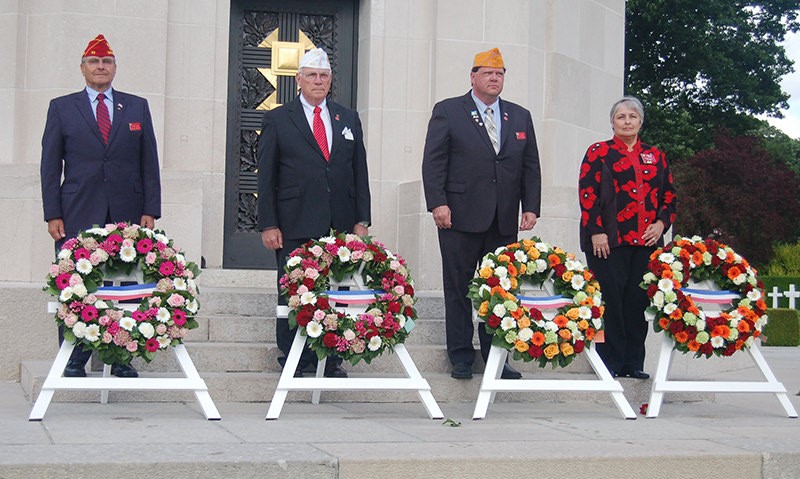
Top leaders of The American Legion Family paid tribute to their organizations' founding generation Tuesday at Flanders Field American Cemetery in Waregem, Belgium.
American Legion National Commander Charles Schmidt, American Legion Auxiliary National President Mary Davis, Sons of The American Legion National Commander Jeff Frain, and American Legion Department of France Commander John Shanahan all placed wreaths at the same cemetery chapel that was originally dedicated by American Legion Past National Commander Harry Colmery, architect of the GI Bill, in 1937.
The Legion Family group was given a tour of the new interpretive center at the historic cemetery where 368 who fought in World War I are laid to rest.
The interpretive center, added in time for increased visitation during the World War I centennial period, includes a hall of sacrifice portraying the stories of some who are buried outside. Also in the center is a 9-minute video that explains both the history and continuing vitality of cemetery.
Prominently featured in the video is an adopt-a-grave program strongly supported by The American Legion's Flanders Field Post BE-02.
Cemetery Superintendent Chris Arseneault, an American Legion member, says that for Memorial Day this year, "easily 85 percent of the graves were decorated by adopters. When you have individual flowers at the headstones, it changes everything."
The American Legion, American Legion Auxiliary, Sons of The American Legion and the Legion Riders of Belgium have adopted one particular grave - that of an unknown soldier - and has made the grave-adoption program one of their marquee activities.
Also involving the Waregem community since 1923 is a tradition of local schoolchildren coming to the cemetery to sing the Star Spangled Banner every Memorial Day. This year, some 900 children were involved.
"The involvement of the local community is amazing," Arseneault said. "I always warn veterans when they come that they are treated like superstars here."
By Jeff Stoffer

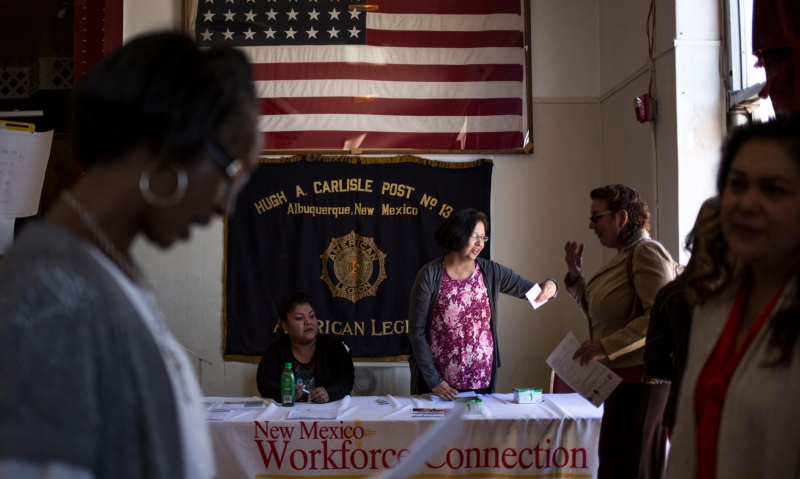
Here’s a look at upcoming career events for veterans, servicemembers and military spouses:
June 21-22: Fort Gordon Transition Summit. Wednesday: 8-8:30 a.m., registration and event kickoff; 9 a.m.-5 p.m., Afterburner Military Transition Seminar; 9 a.m.-2 p.m., MOAA Military Spouse Symposium; 9 a.m.-4 p.m., industry briefs for job seekers; 5-7 p.m., networking reception. Thursday: 8:30-9:30 a.m., job seeker registration; 9:30 a.m.-noon, event kickoff, employment workshops and panel discussion; 1-4 p.m., hiring fair. Multiple venues, Fort Gordon, Ga.
June 21: Fort Lee Job Fair. 10 a.m.-2 p.m., Regimental Club, 2609 C Ave., Fort Lee, Va.
Follow the links for full details and keep tabs on upcoming career fairs at http://www.legion.org/careers/jobfairs.

WASHINGTON (AP) -- The Senate approved broad legislation Tuesday to make firing employees easier for the beleaguered Department of Veterans Affairs, part of an accountability effort urged by President Donald Trump following years of high-profile problems.
The bipartisan measure passed by voice vote. It comes more than three years after a 2014 scandal at the Phoenix VA medical center, where some veterans died while waiting months for appointments. VA employees created secret lists to cover up delays.
The bill would lower the burden of proof needed to fire employees - from a "preponderance" to "substantial evidence," allowing a dismissal even if most evidence is in a worker's favor.
The American Federation of Government Employees, the largest federal employee union, opposed the bill. But the measure was viewed as more in balance with workers' rights than a version passed by the House in March, mostly along party lines. The Senate bill calls for a longer appeal process than the House's version - 180 days vs. 45 days - though workers would not be paid during that appeal. VA executives also would be held to a tougher standard than rank-and-file employees.
The bill now goes back to the House, where the revisions are expected to be approved.
Trump praised the bill Tuesday night and urged the House to act quickly. "Senate passed the VA Accountability Act," he wrote on Twitter. "The House should get this bill to my desk ASAP! We can't tolerate substandard care for our vets."
The VA has been plagued by years of problems, and critics complain that too few employees are punished for malfeasance. The Associated Press reported last week that federal authorities were investigating dozens of new cases of possible opioid and other drug theft by employees at VA hospitals, even after the VA announced "zero tolerance" in February. Since 2009, in only about 3 percent of the reported cases of drug loss or theft have doctors, nurses or pharmacy employees been disciplined.
"The overwhelming majority of the people who work at the VA are good, hard-working employees who serve our veterans well," said Sen. Marco Rubio, R-Fla. "But it has become clear under the current law the VA is often unwilling or unable to hold individuals appropriately accountable for their actions and misdeeds."
He was a lead sponsor of the bill along with Democrat Jon Tester of Montana and Republican Johnny Isakson of Georgia.
"To shield employees from consequences brings down the entire department, it demoralizes the workforce and undermines the core mission of the VA," Rubio said.
The Senate bill would codify into law a Trump campaign promise - a permanent VA accountability office, which was established in April by executive order. The legislation would give the head of the accountability office more independent authority and require regular updates to Congress. The office would also maintain a toll-free number and website to receive anonymous whistleblower disclosures.
In a "State of the VA" report released last week, VA Secretary David Shulkin described an employee accountability process that was "clearly broken." He said the VA had about 1,500 disciplinary actions against employees on hold, citing a required waiting period of at least a month before taking action for misconduct.
Dan Caldwell, policy director of the conservative Concerned Veterans for America, hailed the bill's passage as "long overdue."
"The regular horror stories have made it clear that veterans deserve much better," he said.
Despite problems at the VA, Congress has had difficulty coming to agreement on a bill. A 2014 law gave the VA greater power to discipline executives, but the department stopped using that authority after the Obama Justice Department deemed it likely unconstitutional. Last month, a federal appeals court temporarily overturned the VA firing of Phoenix VA hospital director Sharon Helman over the wait-time scandal.
---
BY HOPE YENASSOCIATED PRESS
SARASOTA, Fla., /PRNewswire-USNewswire/ --
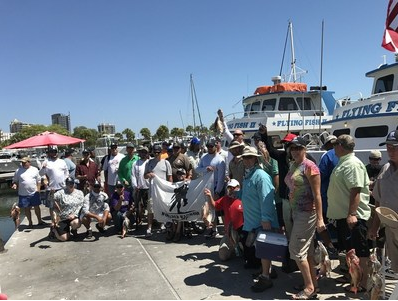
Angel Alvarez didn't catch any fish during a recent Wounded Warrior Project® (WWP) fishing trip, but he didn't feel like he went home empty-handed.
The Army veteran found the camaraderie and tranquility that helps heal his combat wounds.
"I didn't catch a thing, but that's not why I was there," Angel said. "I wanted to enjoy the fishing experience and be around other warriors. I found peace of mind being with them."
Once the boat was in the Gulf of Mexico, warriors shared their experiences and felt empowered as they worked together to catch fish in a comfortable setting.
Peer support plays an important role in the recovery process as injured veterans rely upon one another's learned experiences when managing day-to-day challenges. This special type of therapy reintroduces injured veterans to the unique bonds experienced during military service. Rarely duplicated in the civilian world, these relationships act as a secure bedrock that paves the road to recovery.
"I went around and checked how everyone was doing," said Army veteran James Smith. "I talked to a lot of warriors about transitioning back into civilian life.
"Once we got out on the water, I think everyone felt relaxed and had a good time."
In a WWP survey of the injured warriors it serves, 29.6 percent of survey respondents expressed physical activity helps them cope with stress and emotional concerns. Programs like this highlight the importance of managing mental health through physical activity and connecting with other veterans.
In the process, James managed to hook a few fish, including a 12-inch mackerel.
"We were eager to get our lines in the water and start catching fish," James said. "Once a warrior caught the first one, everyone's attitude really picked up. Most caught between two and five fish, but some caught up to 10.
"But it really wasn't about the fishing. It was about bonding with other warriors and enjoying the day."
To learn and see more about how WWP's programs and services connect, serve, and empower wounded warriors, visit http://newsroom.woundedwarriorproject.org/, and click on multimedia.
LAS VEGAS, /PRNewswire-USNewswire/ --
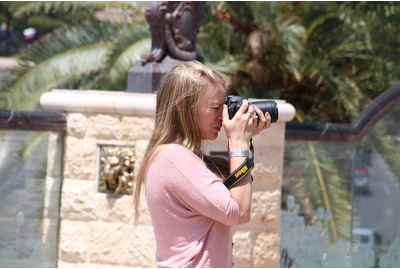
A recent Wounded Warrior Project® (WWP) photography class empowered Denise McCarson to rely on her own conceptual instincts – not the camera's automatic function – to create breathtaking images.
The National Guard veteran borrowed a camera and started taking pictures several years ago while she was deployed. When she returned home, she bought her own camera, and photography quickly turned into one of her favorite hobbies.
"I realize I have control over the camera settings," Denise said. "I decide what I want my photo to be, not the camera. I've taken thousands of photos in the past, but now they're so much better. Photography is one thing that gives me so much pleasure."
Thanks to generous donors, WWP programs and services like the photography class are offered free of charge to warriors, their caregivers, and families, and they assist with mental health, physical health and wellness, career and benefits counseling, connecting warriors with one another and their communities, and long-term care for the most seriously wounded.
Not only does Denise take better pictures now, but the camaraderie of the class put her recovery in better focus. By connecting with other veterans and sharing their experiences with one another, all were comfortable to be more creative with their photo ideas.
"I am a part of something that is greater than me," she said. "I am a part of something that helps others with the same or similar issues. When you're with other warriors, nobody looks at you like you're a broken human.
"If it were not for these Wounded Warrior Project events, I may still be sitting in my room, lying in bed waiting for the day to end."
The 2016 WWP Annual Warrior Survey highlights the importance of connection at WWP outreach events. These settings support the long-term recovery of warriors with physical injuries and social anxieties.
"The photography class helped me get back something I felt I lost when my military career was over," Denise said. "Now I'm ready to explore other things that make me happy."
To learn and see more about how WWP's programs and services connect, serve, and empower wounded warriors, visit http://newsroom.woundedwarriorproject.org/, and click on multimedia.
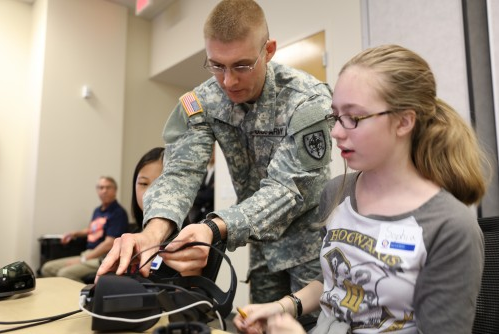
Military Kids Learn About Prosthetics Using Virtual, Augmented Reality
TO: Education and science reporters, calendar and weekend assignment editors
WHAT: Hands-on prosthetic/virtual and augmented reality STEM workshop for military children at the Uniformed Services University of the Health Sciences (USU), in Bethesda, Md., sponsored by the Johns Hopkins Applied Physics Lab, Laurel, Md., and USU’s Department of Physical Medicine and Rehabilitation.
WHEN: June 3-4, 2017, 9 a.m. – 5:00 p.m.
WHERE: Uniformed Services University of the Health Sciences, Bethesda, Maryland. THIS EVENT IS ON A CLOSED MILITARY BASE. INTERESTED REPORTERS MUST CONTACT SHARON HOLLAND OR SARAH MARSHALL NO LATER THAN 12:00 NOON ON FRIDAY, JUNE 2. Contact info is listed above.
WHY: Approximately 20 middle school-aged children of military service members, will use prosthetic limbs and virtual and augmented reality to gain a deeper understanding of the healing process of an amputee while learning science, technology, engineering and math (STEM) topics in a fun, interactive workshop at USU this weekend. Students will explore human anatomy (specifically the brain, nervous system, and muscular system) using a Hololens and will explore prosthetics using an Occulus Rift through playing pre-programmed coordination games. The workshop was developed by the Johns Hopkins Applied Physics Laboratory (APL) through a grant from the Office of Naval Research. Prosthetics experts from USU and APL will lead the Connecting STEM Outreach Now Using VIE Education for Youth, or CONVEY, workshop. Through demonstrations, games and activities, the students will work in pairs and groups, learning STEM concepts, as well as fundamentals of anatomy and physiology. The interactive activities will culminate in a virtual-reality competition, engaging the students and evaluating what they learned. The goal is to help cultivate an emotional connection unique to these children that may motivate them to pursue STEM careers.
# # #
KANSAS CITY, Mo. —
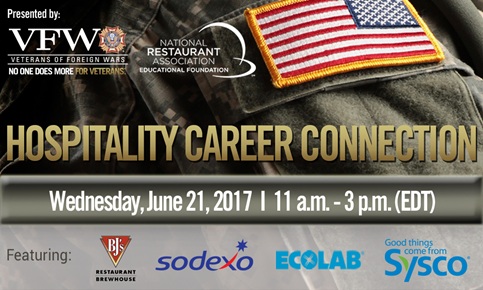
The Veterans of Foreign Wars of the U.S. and the National Restaurant Association Educational Foundation (NRAEF) are teaming up to help service members, veterans and their spouses explore career opportunities and apply for openings at some of the restaurant and hospitality industry’s top companies.
The Hospitality Career Connection virtual career fair takes place June 21 from 11 a.m. to 3 p.m. EDT, and includes businesses such as BJ’s Restaurants, Ecolab, Sodexo and Sysco. Participants are strongly encouraged to preregister for the Hospitality Career Connection and upload their resume by visiting http://www.nraefcareerfair.org. Registration is also permitted during the event.
The Hospitality Career Connection will align candidates with a wide array of positions ranging from culinary arts and food service to restaurant management, construction and environmental services. More than 500 veterans, service members and their spouses participated in last year’s virtual career fair.
More than 250,000 servicemen and women will separate from active duty each year for the next five years and the restaurant, foodservice industry is expected to create more than 800,000 new jobs in the next five years.
“The VFW is thrilled to be teaming up with the NRAEF again,” said VFW National Commander Brian Duffy, Air Force veteran and retired UPS assistant chief pilot. “Coordinating large-scale hiring initiatives like our June 21 event help to ensure our service members, veterans and their spouses have every opportunity available to help them find the post-military career success they deserve.”
“We have a decades-long tradition of supporting our U.S. military veterans and active duty service men and women,” said Gordon Lambourne, VP, Communications, NRAEF. “We are excited to again partner with the VFW on this unique opportunity to connect potential employers with members of the military to learn about opportunities in our industry and match their skills, training and talents with meaningful restaurant, foodservice and hospitality jobs and careers.”
The American Legion
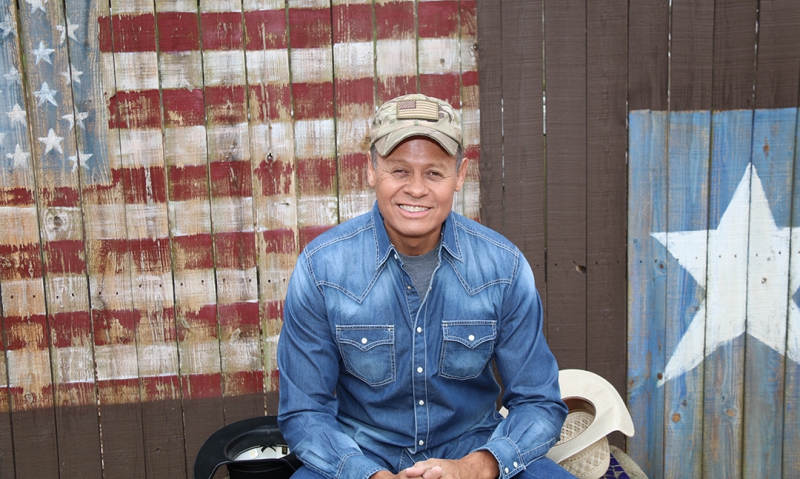
Country star Neal McCoy will both serve as master of ceremonies at the opening of the 99th American Legion National Convention in Reno, Nev., on Aug. 22, and perform at the National Commander’s Banquet that evening. He recently spoke with the Legion on how a big part of his career has been about reaching out to others, and his excitement about spending time in Reno with “great patriots.”
What do you consider the driving force in your musical career? What keeps you going?
I enjoy people. I try to bring joy to a lot of people’s lives. I’m in a business where I get to do that.
What is your proudest moment as an artist?
All my USO work (McCoy has been on 15 tours since 2001). I’ve been to Iraq seven times, Afghanistan, Pakistan. It’s not even always to entertain – we can’t always – but to shake a hand or hug a neck, and tell them I appreciate them.
How did you get involved with the USO? Do any memories stand out among your tours?
My grandfather served in World War I, and my dad served during Korea in the Army in the Philippines; that’s where he met my mother. One of my first tours was in 2001 at Christmas; we flew into the Kandahar airport. I went with Drew Carey, Wayne Newton and the Dallas Cowboys Cheerleaders. We were about the first civilians; the troops had been there about 45 days. I gave an acoustical performance. It was so intense and so rewarding. I was so appreciative of what these younger folks were doing for our country.
What else does your humanitarian work focus on?
Ronald McDonald House, St. Jude’s and the charity my wife and I started, the East Texas Angel Network. We’re fortunate to have two healthy children. When our records were working good, I got booked for lots of benefits. People would pat you on the back. Eventually I wanted to start meeting the kids; the first I met was a 9-year-old bone marrow patient who later died. Today, we’ve helped over 500 families.
What inspired you to start your daily Facebook Pledge of Allegiance? What kind of feedback have you gotten?
I started it on Jan. 7, 2016, before Facebook Live; I started out posting the text and asked people to write it back. It was in the midst of the presidential campaign, and mud was being slung. And one day I just told myself I was going to post the Pledge. I sing it when I say it; things are easier to remember when it’s a melody. I’m going to try to put it to music.
My mother was 13 when the Japanese invaded the Philippines, at about the same time as Pearl Harbor. She told her kids that we ought to be appreciative of the American military and democracy. I’ve never forgotten it.
Is there a Legion history in your family?
My grandfather was in it.
What are you most looking forward to at the convention?
Being around those great patriots … I love people who love their country. An American Legion post’s goal is to give people a place to go to show their love of country.
http://www.nealmccoy.com/
https://www.facebook.com/nealmccoymusic/
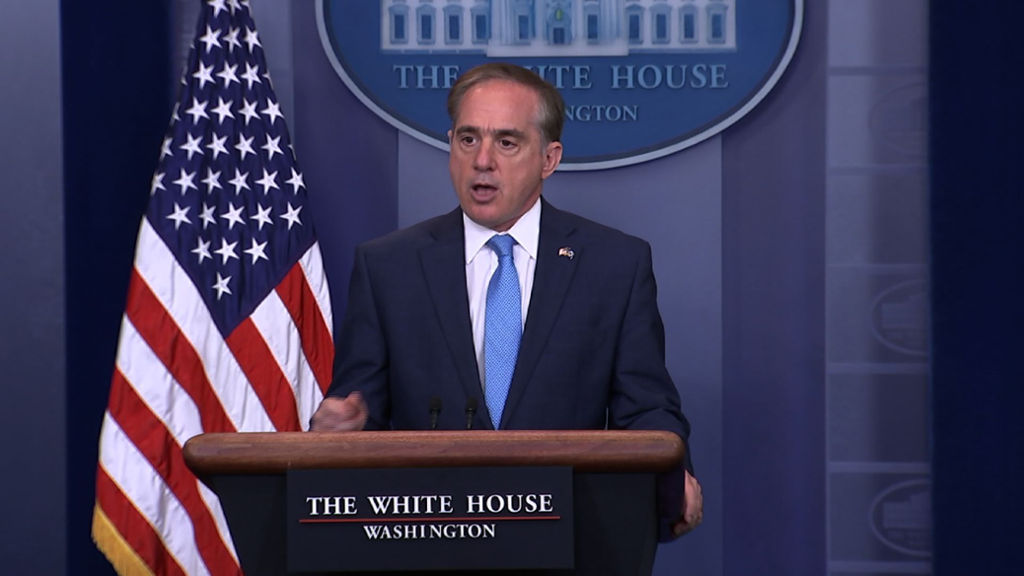
WASHINGTON (AP) -- Veterans Affairs Secretary David Shulkin warned Wednesday that the VA is "still in critical condition" despite efforts that predate his tenure to reduce wait times for medical appointments and expand opportunities to seek care in the private sector.
In a "State of the VA" report, Shulkin, a physician, issued a blunt diagnosis: "There is a lot of work to do."
Veterans can get "same-day" services at medical centers but are still waiting too long - more than 60 days - for new appointments at about 30 locations nationwide. Many primary care centers are understaffed or running out of space. Appeals of disability claims remain backed up with years of wait. Inventory systems at several VA facilities are woefully out of date, and employee accountability is "clearly broken."
Shulkin said the department had about 1,500 disciplinary actions against employees on hold, citing legal requirements that it must wait at least a month before taking action for misconduct. That means people are being paid "for violating our core values," he said in a 17-page report.
"Our veterans and their families have benefited from our early success, but have suffered due to the failures of the past to effect real change," Shulkin said.
Shulkin provided his "top to bottom review" at a critical time. His biggest proposals for revamping the VA - and fulfilling the campaign promises of President Donald Trump - will need to be acted on soon by an increasingly polarized Congress if measures are to be passed by this fall.
The wish list includes an accountability bill to make it easier to fire VA employees, expanding the Veterans Choice program of private-sector care and stemming veterans' suicide. About 20 veterans take their lives each day. "That should be unacceptable to all of us," Shulkin said at a White House briefing.
Other efforts include an overhaul of information technology systems, plans to reduce 400 vacant buildings and 735 underutilized facilities, consolidation at VA headquarters in Washington and partnerships with local governments and the private sector.
Shulkin announced that a promised White House hotline for veterans' complaints should be fully operational by Aug. 15. Testing begins Thursday. The telephone number is (855) 948-2311. During the campaign, Trump promised a 24-hour hotline so veterans' complaints will not "fall through the cracks."
Shulkin, who served in the Obama administration and was promoted by Trump, described the president as being "deeply engaged" on veteran issues, a subject Trump highlighted during the campaign. He pledged to make the department and its health care system work better for veterans.
"His commitment to being involved in veteran issues is one of his top domestic priorities," Shulkin said at the briefing. "Anything that we need, the White House has been extremely responsive and they are impatient and anxious for us to get on with this."
Trump's budget plan calls for a 3.7 percent increase in total VA funding, mostly to pay for rising costs of medical care. It specifically calls for $29 billion over the next decade for Choice, which allows veterans to seek outside medical care from private doctors.
To cover rising costs, the VA would cap the amount of educational benefits veterans could receive under the GI bill and halt "individual unemployability" benefit payments to out-of-work disabled veterans once they reach age 62. Major veterans' organizations oppose such cuts, with the American Legion describing the trade-offs as "stealth privatization." Veterans' groups worry the Trump administration is seeking to expand Choice to the detriment of core VA programs.
Besides Choice, Shulkin said he was seeking to implement another campaign priority: a VA accountability office, established by executive order last month,
Shulkin said he still needed the Senate to pass accountability legislation that would give him broader authority, such as lowering the evidentiary standard to fire employees. The Senate is scheduled to vote on the bill June 6.
The Associated Press reported this week that federal authorities were investigating dozens of new cases of possible opioid and other drug theft by employees at VA hospitals, a sign the problem isn't going away after the VA announced "zero tolerance" in February. Since 2009, in only about 3 percent of the reported cases of drug loss or theft have doctors, nurses or pharmacy employees been disciplined.
---
BY HOPE YEN AND DARLENE SUPERVILLEASSOCIATED PRESS
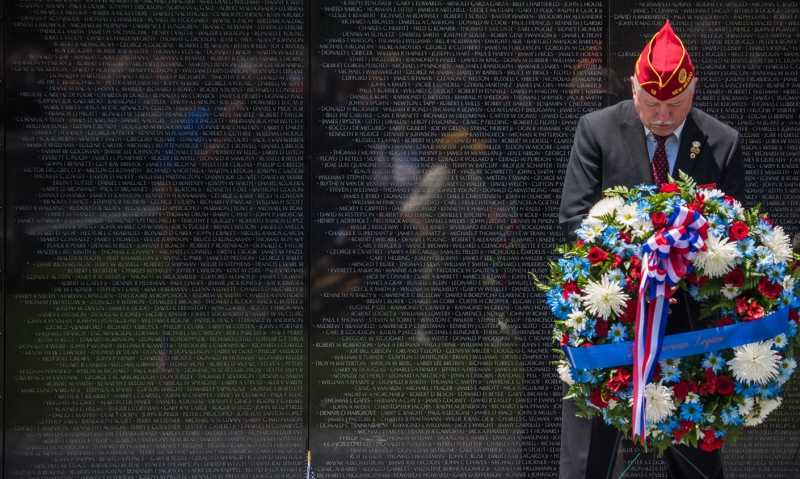
Clotilde Szelkowski remembers John Souther as an “all-around wonderful person” who could be a fun-loving prankster with a serious side.
Souther’s memory is what motivated Szelkowski to make the trip from Colorado to Washington, D.C., for Memorial Day commemorations at the Vietnam Veterans Memorial.
“The ultimate sacrifice my brothers and sisters paid is what brings me out today,” said Szelkowski, a member of Post 1 in Denver. “I don’t remember when (Souther) was killed. I don’t want to remember. I just know he’s there on the Wall, and he is probably the No. 1 reason. But the others are the No. 1.1 reason. None of them are any more important than the others.”
Szelkowski, who served as a Navy corpsman, visited Souther’s name on the Wall. “I try to remember when we were kids because that’s when I knew him. Otherwise I totally break down.”
This year marks the 35th anniversary of the Wall. During the Memorial Day Observance at the Wall ceremony on Monday, American Legion National Vice Commander Paul Espinoza laid a wreath on behalf of the nation’s largest veterans organization.
“To be laying the wreath fills my heart,” said Espinoza, of New Mexico. “They did something out there for us so that we can be out here today at the Wall honoring them.”
Espinoza reminded Americans about the true meaning of Memorial Day.
“Memorial Day is about your close loved ones who have passed away — to remember them and to remember all veterans,” Espinoza said. “It’s also important for civilians to remember all Vietnam War veterans, how hard it was for them out there and how we lost them. So many are still missing. Keep them in your heart and every day remember why you are living in the United States of America.”
Julie Kink knows the sacrifice all too well.
She is a Gold Star sister of helicopter pilot David Kink, who was killed in 1969 at age 19.
“David lost his life after one month in Vietnam when his helicopter crashed due to a ground explosion,” she said. “I was 8. I barely knew him. The lanky, gentle big brother I said goodbye to at a Madison, Wis., airport in 1969 would be 67 years old today. I have seen 17,000 more sunsets than he had a chance to see.”
Referring to the memorials, she said, “these things ensure that America will never forget.” But it took her time to be able to let herself learn more about her brother’s service in Vietnam.
“For those of us who lost someone over there, there was an unwritten rule you cannot talk about the war. Not here, not now,” she said, reflecting to a different era. “Today it is OK to talk about Vietnam.”
It took Kink 25 years to be able to talk to people about her brother and reach out to his fellow veterans who knew him. “Eventually I found men who trained and flew with David who helped me learn not only how he died but more importantly how he lived. Finding his friends has brought me closer to David,” she said.
Veterans who served side-by-side with those memorialized on the Wall exchanged handshakes, war stories and greetings of “Welcome home, brother.” They also paused to remember their fallen comrades.
Mark Muller, who lives in Delaware but is a member of Post 331 in Stone Harbor, N.J., made his first visit to the Wall on Memorial Day.
“I have three friends who are enshrined on the Wall,” said the Navy veteran who was in country 1965-66. “I felt obligated to come down here for them and the other guys on the Wall.”
Danny Monahan was one of those friends who Muller has never forgotten. “He got killed on his second tour,” Muller recalled. “His daughter was born after he left home. Such a waste.”
Reggie Knight, a 68-year-old Army veteran, lives in the nation’s capital and visits the Wall several times annually, including every Memorial Day.
“It’s been 47 years and I haven’t forgotten,” said Knight, a Legionnaire. “It’s such a tragedy. Too many men and women lost their lives. I haven’t forgotten them.”
By Henry Howard