News
WASHINGTON –
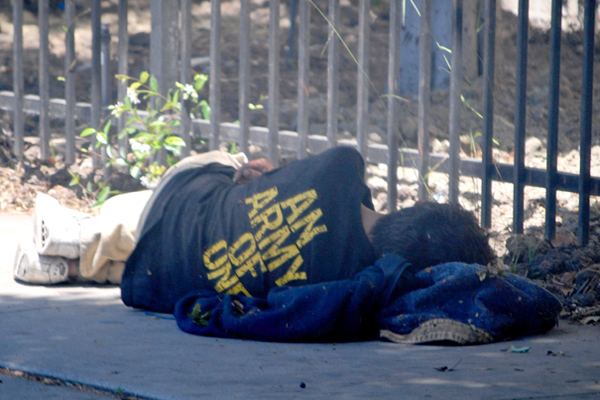
The Department of Veterans Affairs (VA) today awarded approximately $300 million more in grants under the Supportive Services for Veteran Families (SSVF) program to help thousands of very low-income Veteran families around the nation who are permanently housed or transitioning to permanent housing. The SSVF grant program provides access to crucial services to prevent homelessness for Veterans and their families.
SSVF funding, which supports outreach, case management and other flexible assistance to prevent Veteran homelessness or rapidly re-house Veterans who become homeless, has been awarded to 275 non-profit organizations in all 50 states, the District of Columbia, Guam, Puerto Rico, and the U.S. Virgin Islands. These grants, key elements of VA’s implementation of the Housing First Strategy, enable vulnerable Veterans to secure or remain in permanent housing. A list of SSVF grantees is located at www.va.gov/homeless/ssvf.asp.
“Since 2010, the Housing First Strategy has helped cut Veteran Homelessness nearly in half,” said VA Secretary Robert A. McDonald. “Housing First is why 360,000 Veterans and family members have been housed, rehoused or prevented from falling into homelessness over the last five years. SSVF helps homeless Veterans quickly find stable housing and access the supportive services they – and their families – need.”
Grantees will continue to provide eligible Veteran families with outreach, case management, and assistance obtaining VA and other benefits, which may include health care, income support services, financial planning, child care, legal services, transportation, housing counseling, among other services.
Grantees are expected to leverage supportive services grant funds to enhance the housing stability of very low-income Veteran families who are occupying permanent housing. In doing so, grantees are required to establish relationships with local community resources.
In fiscal year (FY) 2015, SSVF served more than 157,000 participants and is on track to exceed that number in FY 2016. As a result of these and other efforts, Veteran homelessness is down 47 percent since the launch of the Federal Strategic Plan to Prevent and End Homelessness in 2010. Also since 2010, more than 360,000 Veterans and their family members have been permanently housed, rapidly re-housed, or prevented from falling into homelessness by VA’s homelessness programs and targeted housing vouchers provided by the Department of Housing and Urban Development. Today’s grant recipients successfully competed for grants under a January 15, 2016, Notice of Fund Availability. Applications were due February 5, 2016. The funding will support SSVF services in FY 2017, which starts October 1, 2016, and ends September 30, 2017.
For more information about the SSVF program, visit www.va.gov/homeless/ssvf.asp.
###


MADISON, Wis. (AP) --
The family of a Marine veteran who died from a toxic mix of more than a dozen drugs at a U.S. Veterans Affairs facility in Tomah, Wisconsin, filed a wrongful death and medical malpractice lawsuit against the U.S. government Monday.
The federal lawsuit filed in Madison, Wisconsin, alleges VA caregivers improperly prescribed and administered drugs to Jason Simcakoski, who was 35 when he died in 2014. It also alleges the VA failed to provide adequate emergency care for Simcakoski when he was found unresponsive and did not properly diagnose his mental health and substance abuse problems.
Last year, the VA's inspector general ruled that deficiencies in care led to Simcakoski's death. One physician who attended to him was fired.
The lawsuit filed Monday by Simcakoski's wife seeks unspecified compensation. It lists the couple's daughter as a plaintiff.
Neither a Justice Department attorney listed in court documents nor a VA representative could be immediately reached by The Associated Press for comment.
According to the lawsuit, a doctor prescribed Simcakoski Suboxone - a drug often used to treat addicts of heroin and other opiates - to alleviate chronic pain and potentially decrease anxiety. The lawsuit alleges Simcakoski was not warned that was an off-label use of the drug or that Suboxone would interact with other medicines he was already taking. It also alleges he was given too high a dosage.
The lawsuit says Simcakoski's family visited him at the Tomah facility hours before his death on August 30, 2014, and his father was concerned because he was "so sedated he could barely speak."
A nursing staff member found him unresponsive at 2:45 p.m., but CPR was not started until 10 minutes later and emergency responders didn't arrive for 20 minutes, according to the lawsuit.
The Tomah facility was dubbed "Candy Land" by some veterans for its prescribing practices. A 2015 VA report concluded that patients at there were more likely than patients at other VA hospitals to receive high doses of pain killers.
The center has said it is committed to improving the care it provides to veterans. Its acting director said after the release of the report on Simcakoski's death that changes were being made to address the problems identified, including improving life-saving emergency procedures and reviewing medications available on emergency crash carts.

SANTA CLARA, Calif. (AP) --
Colin Kaepernick's protest of the national anthem is apparently winning support from some military veterans on Twitter.
The San Francisco 49ers quarterback sparked controversy during the NFL's preseason by sitting instead of standing during the "Star-Spangled Banner." Kaepernick says he's protesting what he describes as oppression of minorities in the United States. Some who have criticized the protest said it was insulting to veterans.
But some people who identify themselves as veterans have tweeted pictures of themselves in uniform and messages of support under the hashtag VeteransForKaepernick . One says he served to protect freedoms, not a song. Another says protesting is every American's right.
Kaepernick says he will continue his protest ahead of Thursday's preseason game in San Diego.
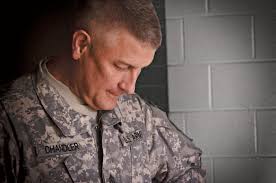
The Army reservist who killed five Dallas police officers last month showed symptoms of post-traumatic stress disorder after returning home from Afghanistan in 2014, but doctors concluded that he presented no serious risk to himself or others, according to newly released documents from the Veterans Health Administration.
Micah Johnson had sought treatment for anxiety, depression and hallucinations, telling doctors that he experienced nightmares after witnessing fellow soldiers getting blown in half. He also said he heard voices and mortars exploding, according to the documents obtained by The Associated Press under the Freedom of Information Act.
"I try to block those out, but it is kinda hard to forget," Johnson told his care provider, according to the documents.
Johnson, 25, was the sniper who targeted the officers at the conclusion of a peaceful march July 7 in downtown Dallas, where demonstrators were protesting fatal police shootings in Minnesota and Louisiana. Armed with an assault rifle, he took multiple positions as he fired. Hours later, authorities used a bomb-carrying robot to kill him.
During his deployment, Johnson was largely confined to base in an area of Afghanistan that had seen heavy combat but that was relatively quiet when his unit arrived in November 2013, according to his former squad leader.
Upon his return to the U.S. nine months later, Johnson told doctors he was experiencing panic attacks a few times a week, including once while at Wal-Mart, where there was an unspecified conflict that required a police response, the records said.
"Veteran states hearing all the noises, fights and police intervening caused him to have palpitations, 'My heart felt like someone was pinching it while it was beating fast,'" the records state. Johnson said he began shaking, felt short of breath and got chills following the Wal-Mart incident.
The records do not show that Johnson was formally diagnosed with PTSD.
The type of screening that he underwent is typically a first step to determine if the patient should be referred for further assessment to a mental health professional, said Joel Dvoskin, a clinical and forensic psychologist in Tucson, Arizona.
Doctors eventually decided that Johnson presented a low risk for suicide or for hurting anyone else.
Johnson was "not acutely at risk for harm to self or others," according to a medical record from a visit on Aug. 15, 2014. The patient was "not felt to be psychotic by presentation or by observation."
The reservist who specialized in carpentry and masonry told health care providers he had lower back pain and was avoiding "crowds of people and when in the public, scanning the area for danger, noting all the exits, watching everyone's actions."
"I feel like I can't trust all of these strangers around me," Johnson told his doctor, who noted that he had taken to drinking since his return to Dallas, consuming three to four shots of vodka up to three times a week. "It's hard for me to be around other people and I am so angry and irritable."
Records from the Aug. 15 visit state that Johnson described his childhood as "stressful." His responses to a section of the form titled "Sexual/Physical/Emotional Abuse History" were redacted. Johnson was also advised to talk with a health care worker about erectile dysfunction.
Johnson was prescribed a muscle relaxant, an antidepressant and anti-anxiety and sleep medication, and a nurse offered him tips on managing anger, records show.
He also saw a psychiatrist and was further evaluated for his PTSD symptoms in September of that year, but the physician noted that his mood was "better."
When providers called Johnson in October 2014, he requested to put off further assessment for PTSD, saying he was busy remodeling his mother's house, according to the records. He had previously told providers he planned to find a job in construction and that his long-term goal was to become a self-defense instructor.
Johnson's mother, Delphene Johnson, has said her son sought medical care from the VA for a back injury but got no help after filling out forms and going to meetings. He "just finally gave up," she told TheBlaze, a news site founded by conservative talk show host Glenn Beck.
Dallas VA spokesman Ozzie Garza did not immediately respond to questions regarding Johnson's treatment within the VA North Texas Health Care System, the second largest VA health care system in the country.
In May 2014, new patients seeking mental health care at the Dallas VA faced a 50-day average wait, then the 10th longest in the nation.
The mother of Gavin Long, the former Marine and Iraq war veteran who killed three law enforcement officers July 17 in Baton Rouge, Louisiana, told PBS' Tavis Smiley that her son had post-traumatic stress disorder and unsuccessfully sought the VA's help.
BY GARANCE BURKEASSOCIATED PRESS
NEW YORK (AP) --
Two congressmen want federal authorities to investigate why a former Navy gunner apparently killed himself on the grounds of a veterans' hospital in New York.
Peter Kaisen, 76, a retired police officer from Islip, was found Sunday in a parking lot at the Veterans Affairs Medical Center in Northport suffering from a gunshot wound to the head.
His wife, Joan Kaisen, told Newsdayhe had been suffering from back pain so bad he was unable to sit for more than a few minutes. Doctors at Northport told her husband earlier this year there was nothing more they could do to ease his suffering, she said.
Tom Farley, a longtime friend and fellow veteran, told The Associated Press that Peter Kaisen visited the hospital once or twice per month but didn't tell anyone where he was headed when he made the 30-mile trip from his home Sunday.
"We all think there is probably some depression," Farley said. "Maybe he wanted meds. Maybe he wanted to sit and talk. I don't know. None of the family knows."
Kaisen's body was found outside his car in a parking lot near a community living center at the edge of the hospital's suburban campus just after noon Sunday, about 10 minutes after he arrived at the site, officials said.
A spokesman for the hospital, Christopher Todd Goodman, declined to discuss Kaisen's patient history at the VA but said the hospital had no evidence that he sought treatment at the emergency room, entered any hospital buildings or had any interactions with staff or patients on the day he died.
"The Northport VA stands ready to cooperate with any investigative body that believes more information is needed," the hospital's director, Philip Moschitta, said in a statement. "At no point did the staff in this facility fail to do the right thing by our patients."
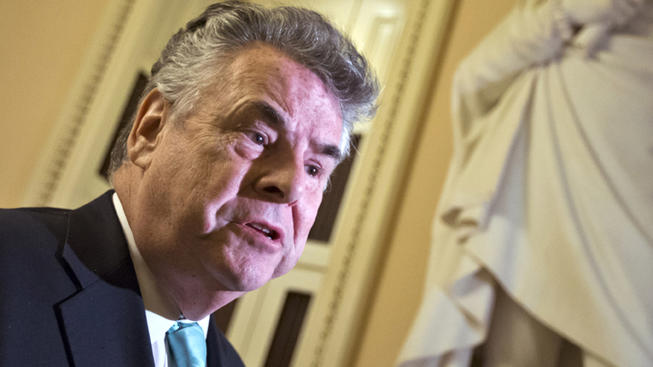
U.S. Reps. Peter King, a Republican, and Steve Israel, a Democrat, sent a letter to the FBI and to the secretary of the Department of Veterans Affairs on Thursday asking for a "transparent" investigation into the death, following a media report - denied by hospital officials - that Kaisen had sought emergency mental health care at the hospital but had been turned away.
"It is critical that our nation's veterans feel they can trust the services provided by their VA medical facilities, and that their health and wellbeing is of the upmost priority," they wrote.
A spokeswoman for the FBI in New York said agents responded to the scene, but since nothing criminal was discovered, a subsequent review would be conducted by the VA.
Joan Kaisen told Newsday her husband served on a Navy supply ship, the USS Denebola, from 1958 to 1962.
BY JAKE PEARSONASSOCIATED PRESS

CONCORD, N.H. (AP) -- A nonprofit group with New Hampshire roots is putting a new spin on back-to-school shopping by helping equip 10 classrooms for refugee children in Iraq.
TentED was created in 2014 by three U.S. Army veterans, two of whom met as student at the University of New Hampshire. Rather than starting from scratch, the group works with existing educational aid programs to raise money and deliver what it calls "last mile" essentials, such as school supplies, bus transportation and recreational activities.
The group has funded about 15 projects in the past two years in the Kurdistan region of Iraq and is partnering with an organization that is building a new school for more than 250 children. Construction started in May and is expected to be done in the next four weeks in time for the fall term, said Billy Ray, Middle East director for the partner organization, World Orphans.
"These kids have got to get back into the routine of school and learning," he said. "The scarring has to stop, and this is our chance to roll back the years that ISIS has stolen from them."
During emergencies - whether natural disasters or manmade conflicts - education gets overlooked, TentEd co-founder Zach Bazzi said. But he argues that approach could result in entire generations of children growing up without basic literacy and critical thinking skills.
"You don't want people starving or going without water or shelter, but I'd also argue that education needs to be up there," he said.
Bazzi served in the Army and Army National Guard from 1997 to 2008 and later worked as consultant and volunteered in refugee camps in Iraq. When he returned to the U.S. in 2014 for graduate school, he teamed up with Scott Quilty, a fellow UNH graduate and Army veteran who lost his right arm and leg to a roadside bomb in Iraq. TentEd's third co-founder is Patrick Hu, an Army veteran Bazzi met when both served in Afghanistan.
All three have day jobs. Hu is a market researcher at AT&T Mobility in Atlanta; Quilty heads MedScribes, a medical staffing company in Durham and Fuquay-Varina, North Carolina; and Bazzi is the Middle East manager for a nonprofit called Spirit of America and is based in Washington, D.C. He frequently travels overseas to implement TentEd activities, identifying and responding to specific needs.
"We don't build schools, we don't design schools. We're simply a rapid, efficient, responsive funding platform," he said.
For the current project, the group is trying to raise $12,500 to outfit 10 classrooms with desks, whiteboards and other materials. Ray said that amounts to about 5 percent of the overall school construction budget, but he greatly appreciates Bazzi's help.
"It feels like he's one of our cheerleaders, and really an advocate for us," he said. "He's basically crowd funding for our projects, and that's just cool."
BY HOLLY RAMERASSOCIATED PRESS
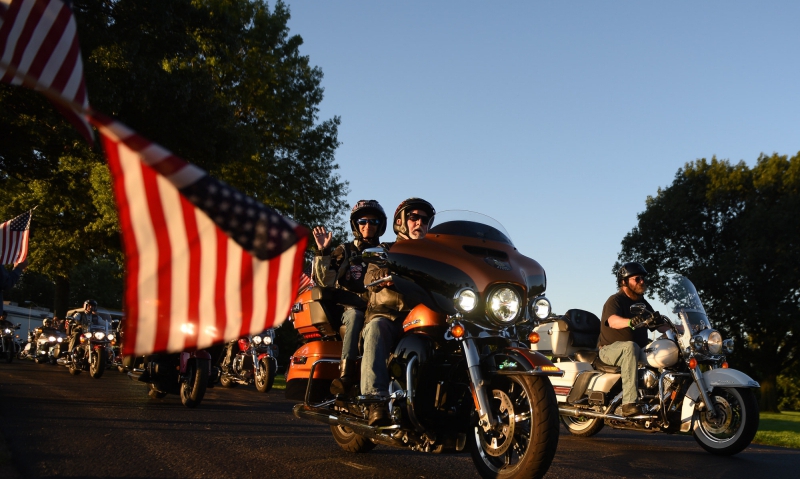
American Legion Social Media Manager Steve Brooks is following along or getting out ahead of the Legacy Run in what has to be a 70-foot long, 32-passenger Ford Transit, with visual journalists Lucas Carter and Clay Lomneth, to cover the 2016 Legacy Run.
6:26 a.m. – Pick up Lucas and Clay at Lucas’ apartment. Having just spent eight days in Shelby, N.C., with the two covering the American Legion World Series, I worry we may run out of things to talk about before we get to Kenneth N. Dowden Wayne Post 64 in Indianapolis.
6:45 a.m. – We get to Post 64, sans any awkward silences.
Charles Gremlich, a member of the Sons of The American Legion Squadron at Post 200 in Boonville, Ind., waits on the overpass at the Odon, Ind., exit to show his support for the Run. “I haven’t seen this many motorcycles together at one time, except for on TV or YouTube,” he says. “I absolutely had to see it.”
7 a.m. – Assistant Road Captain Theardies “T-Man” Fisher, a member of Post 4 in Wichita, Kan., preps his bike. He’s on his ninth Legacy Run. “It’s like a new beginning,” he says of the first day of the Run. “Then you roll out and it all falls into place.” And why come back year after year? “"You get the bug,” he says. “It's for the kids, man. It's all for the kids."
7:11 a.m. – “Ride your ride, but stay tight,” Chief Road Captain Bob Sussan says during a ride briefing. “Ride safe.”
7:30 a.m. – Sussan is like a Swiss watch, and the Run leaves Post 64 at its appointed time. More than 290 motorcycles leave the post.
9:11 a.m. – The Run makes its first gas stop at a Walmart in Bloomington, Ind. – home of Indiana University, the greatest college in the history of the world. A similar Ford Transit van, looking like it has gone through a demolition derby or two, passes in front of us. “That’s what our van is going to look like when we’re done,” Clay says.
10:53 a.m. – On the same bridge, Post 64 members Linda Todd and Rick Fatout have driven nearly 90 miles to hold a flag as the Run passes. They’ve made it a tradition to do so when the ride heads out along I-70 near their post, but the Run didn’t use that route this time. “They deserve this because of what they’re doing for the kids who’ve lost their parents,” Todd says.
10:41 a.m. – We’ve now passed into Central Time and have gained an hour. We spent the first part of that bonus time on an overpass at the exit for Oakland City, Ind., where members of the Oakland City Fire Department have brought a fire truck holding a large U.S. flag. Legionnaires from area posts and other locals were there waving smaller flags as the Run passes underneath. Oakland City Fire Department Capt. Scott Trotter salutes the entire ride. “It’s an honor that The American Legion is coming through here,” he says. “We wanted to be here for the veterans.”
11:04 a.m. – Soon after, on the Exit 27 overpass, the Buckskin Volunteer Fire Department has a similar display set up. Future overpasses also will have supporters lining them.
12:05 p.m. – We arrive at the LST-325 Memorial in Evansville, Ind. The ship served in World War II in operations in North Africa and Italy, as well as on Omaha Beach during D-Day. Several TV stations are there to cover the ride.
12:12 p.m. – Pete Snowden is a student at the University of Southern Indiana. He’s also the commander of Post 324, which was established at the university in 2014. “The guys that are doing the ride and raising the money … anything we can do to help them out,” Snowden says. “It’s an honor for us.”
12:56 p.m. – The Run arrives at the memorial and are served lunch courtesy Post 324.
1:25 p.m. – Craig Pulver, the adjutant and a Legion Rider from Post 84 in Otsego, Mich., is on his first Legacy Run. He tears up when asked about his reaction to the flags and people standing along the overpasses on the highway. “It’s awesome,” he says. “You can’t ride underneath one of those without thinking other things: Guys that you had to leave behind and what we’re doing now. It’s just great.”
2:05 p.m. – National Commander Dale Barnett and Past National Commander Jim Koutz are among those taking part in a wreath-laying ceremony at the LST-325 Memorial. Barnett praises Indiana’s Eighth District for its hospitality and for the support the Run has seen so far.
3:45 p.m. – I want a chocolate-dipped cone. Clay concurs it sounds good. So we find a Dairy Queen roughly five minutes from our next stop. I get the dipped cone; Clay and Lucas go for Blizzards. Lucas is somewhat dismayed the restaurant’s happy hour is only on weekdays.
4:07 p.m. – The Run arrives at the Kentucky Veterans Cemetery West for a wreath-laying ceremony. More than 30 Kentucky Legion family members are waiting and greet the group with applause.
4:16 p.m. – Richard Page, commander of the honor guard at Post 236 in Calvert City, Ky., is at the cemetery, along with approximately 17 other members of his honor guard. “We just want to honor these Riders for what they’re doing,” says Page, who traveled an hour and 20 minutes to get here. “It’s a wonderful thing, and I believe we need to support what these folks are trying to do.”
4:55 p.m. – We pull into Fort Campbell Post 233 in Oak Grove, Ky. There, Michael “Joker” White – a past ALR chapter director there – has been cooking 200 hot dogs and hamburger over charcoal for two hours.
5:12 p.m. – The ride pulls into Post 233. “We want to do whatever we can for the Legion Riders on the Legacy Run,” White says. “We’re definitely proud to have them stopping here.”
5:15 p.m. – National Commander Dale Barnett, who rode a couple legs of the ride on the back of Georgia Legionnaire Bob Brown’s bike, says the idea for his Awareness Walks for Veterans came from, in part, the Legacy Run. “They had some real vision about how to reach out and be aware,” he says. “My project this year was awareness walks – to get out of the post. I took a lesson from the Legacy Ride because I saw how successful it was. It’s the same concept: It’s getting out in a community and telling our story.”
5:45 p.m. – Donations are presented, including $6,000 from Post 14 in Ponca City, Okla., and $4,000 from the Legion family at Post 253 in Royal Oak, Mich. The total for the day is $25,575, bringing the amount raised so far to $428,239.76.
NOTRE DAME, Ind. -
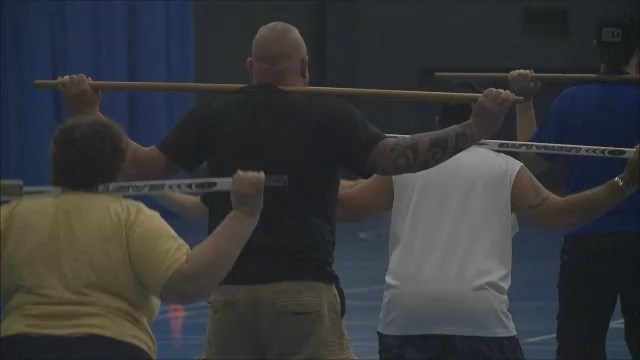
Notre Dame opened up one of their gym facilities to over 30 men and women looking to take part in a warrior workout.
Whether to progress mentally or physically-
“For me I think it’s all about the confidence, you know so you’re in here you’re doing stuff, you’re getting active you’re interacting with people,” said Joe Weismantel.
These warriors are working to overcome service-related injuries.
“We’re just showing them that although they have those injuries, they have a new normal now. So it doesn’t mean you can’t do something, you just gotta do it a little bit differently,” said Samantha Eldridge, the Physical Health and Wellness Coordinator for Wounded Warrior Project.
The Wounded Warriors Project is a non-profit organization helping to honor and empower recovering warriors.
“They were starting to see tons of troops coming back from overseas with injuries and so they really felt the need to support these guys who were coming back in any way that they could,” said Eldridge.
They teamed up with Notre Dame athletic coaches to host a warrior workout Monday at the Joyce Center.
“Events like this is hopefully a good kick start back into the fitness world,” said Eldridge.
Their goal with this event is to help veterans in their recovery process as they continue to transition into their normal lives.
“People of all different categories and different injuries and different situations are making it through and are progressing and doing better and working with each other and not just kind of going quiet into the night,” said John Iversen.
“You know, you’ve got world class athletes being trained by these folks so they’re teaching us some really good stuff,” said Weismantel.
If you’re a veteran looking to attend one of the upcoming events-
“We have 20 different programs and they’re all free to our veterans and service members.” said Eldridge.
You can find out more information about their programs by clicking here.
By Andrea Alvarez

The Red Knights New York Chapter 42 motorcycle club will hold its fifth annual “Bucket Brigade” charity ride Aug. 27 to benefit The Wounded Warrior Project.
The cost of the ride is $15 for drivers and $5 for passengers. Registration will be from 8 a.m. to 9:30 a.m. at The Bath Volunteer Fire Department, 50 E. Morris St. in Bath.
The ride will start at 10 a.m. at the Bath Volunteer Fire Department, and riders will travel approximately 100 miles around the Finger Lakes region, finishing at the Hammondsport Fire Department.
There will be food and drinks available for purchase along with raffles, a silent auction, a 50/50 drawing, and live music.
Last year's ride raised more than $4,500 and overall, the annual ride has raised more than $17,600 for the Wounded Warrior Project.
For more information, call 814-203-0029 or email ny42@redknightsmc.com.
by Jeff Murray
The Legacy Run is about raising money for The American Legion Legacy Scholarship Fund. But on Monday, the Legacy Fund briefly took a backseat to one of the Legion’s other critical funds: Operation Comfort Warriors (OCW).
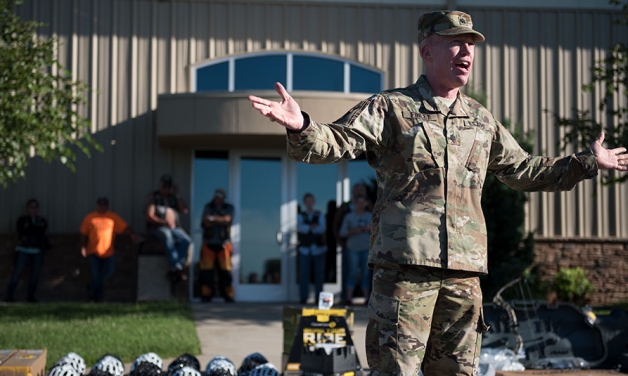
Before more than 300 Legion Riders and their passengers departed Oak Grove, Ky., they witnessed an OCW donation to the Warrior Transition Battalion (WTB) at nearby Fort Campbell. A gift of $15,000 worth of items was presented to the WTB leadership at the Valor Hall Conference and Event Center.
The donation included two NordicTrack treadmills, archery compound bows, arrows, bicycle/wheelchair racing gloves, bike helmets, stationary bike trainer blocks and three portable shelter canopy tents to provide recovering servicemembers with shaded areas. The donation also included 100 MP3 players pre-loaded with a program that will help servicemembers dealing with sleep issues to get into their REM-cycle of sleep without having to use medication.
During his tenure as national commander from 2012-13, Jim Koutz helped raise more than $1 million for OCW. He was on hand for the donation. “It’s just something we need to do to take care of our troops,” he said. “We just don’t go buy a bunch of items and take it to the troops. This is what the commanding officers at these Warrior Transition Units tell us that (recovering servicemembers) have been asking for.”
Lt. Col. Chip Finley, commander of the Fort Campbell Warrior Transition Battalion (WTB), was on hand to accept the donation. He said the approximately 250 servicemembers recovering at Fort Campbell will greatly benefit from the items.
“I greatly appreciate you guys’ efforts,” Finley said. “Roughly 85 percent of the soldiers (in the WTB) will never, ever wear a uniform when they leave our battalion. They head out as veterans to hopefully do great things. Part of that rehabilitation … are things like this (donation). With this equipment that we truly, definitely need, this will help us provide a start for them. We could not do this without your efforts and your contributions.”
Brian Keller, the state sergeant-at-arms for the Department of Missouri’s Legion Riders and a member of Sons of The American Legion Squadron 347, helped OCW coordinator Bruce Drake pack up the equipment and deliver it to Valor Hall.
“It shows how much we support them (and) how much we want them to get better to proceed with their healing,” Keller said of the donation. “These are tools to help them do it. This is the whole reason I joined (the SAL): to give back. I wasn’t a warrior. I was looking for my way to give back.”
By Steve B. Brooks